7 Staffing Services Industry Trends Driving Growth in 2026
Industrial staffing services have become a critical solution for businesses facing workforce shortages, rising labor costs, and increasing production demands. Whether you run a manufacturing plant, warehouse, or engineering operation, finding the right people at the right time can feel like solving a moving puzzle.
That’s where staffing services step in. They act like a bridge—connecting skilled workers with companies that need them fast.
In today’s competitive market, industrial staffing is no longer optional; it’s a strategic advantage. Companies that use staffing services hire faster, reduce risks, and stay flexible, even during uncertain economic conditions.
What is the Staffing Services Industry?
The staffing services industry is a sector focused on helping businesses find, hire, and manage talent efficiently. At its core, a staffing agency acts as a middle partner between employers and job seekers.
Think of it like a talent marketplace. Companies bring their hiring needs, and staffing firms provide pre-screened candidates ready to work.
How Staffing Agencies Operate
Staffing agencies follow a structured process:
- Understand company requirements
- Source candidates from talent pools
- Screen and evaluate applicants
- Match candidates to job roles
- Manage onboarding and sometimes payroll
This makes hiring faster and more efficient compared to traditional methods.
Staffing vs Recruiting vs Workforce Solutions
- Staffing services focus on flexible hiring (temporary, contract, project-based roles)
- Recruiting services focus mainly on permanent placements
- Workforce solutions include end-to-end services like planning, compliance, and talent strategy
Why It Matters Today
With increasing labor shortages and skill gaps, businesses need agile hiring solutions. Staffing firms provide:
- Immediate hiring support
- Access to wider talent pools
- Reduced hiring risk
3. Types of Staffing Services Explained
Industrial staffing is not a one-size-fits-all solution. Every business has different hiring needs depending on production cycles, project timelines, and workforce stability goals. That’s why staffing agencies offer multiple service models—each designed to solve a specific workforce challenge.
Think of these models like tools in a toolbox. You don’t use a hammer for every job—you pick the right tool based on the task.
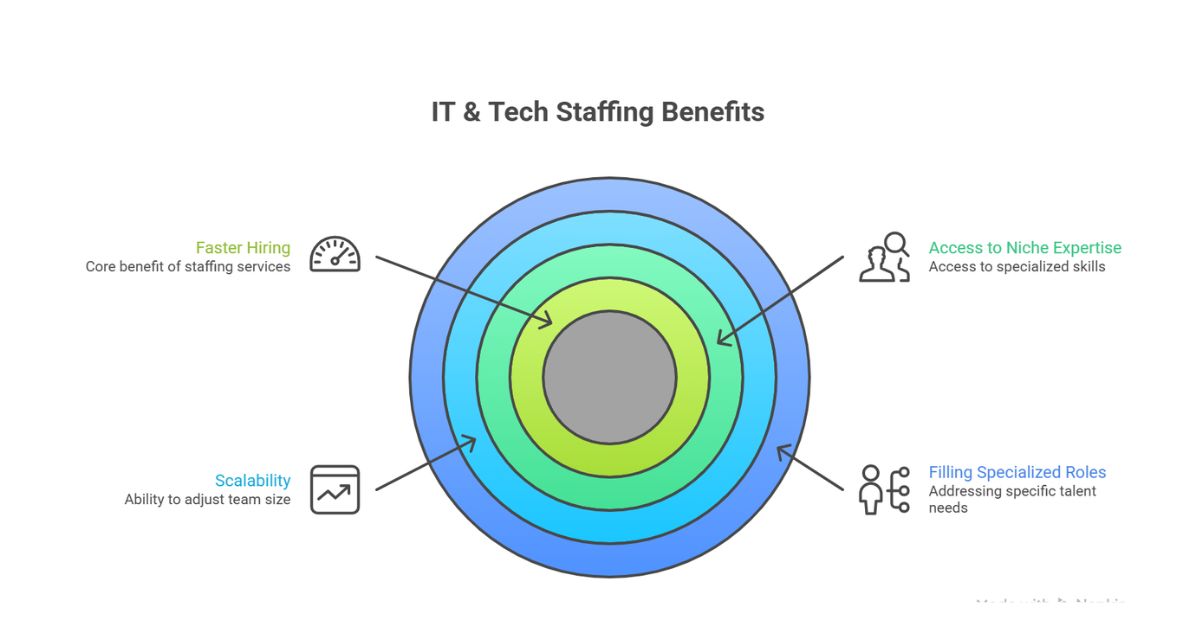
3.1 Temporary Staffing
Temporary staffing is one of the most commonly used staffing solutions in industrial environments. It allows companies to hire workers for a short, defined period—ranging from a single shift to several months.
This model is especially useful when workloads fluctuate. For example, a manufacturing plant may need extra workers during peak production seasons or large order fulfillment periods. Instead of over-hiring full-time staff, temporary workers help maintain productivity without long-term commitments.
Best for:
- Seasonal demand spikes
- Covering employee absences (leave, sickness)
- Short-term production increases
- Emergency workforce shortages
Key advantage: You get immediate workforce support without increasing permanent headcount.
3.2 Contract Staffing
Contract staffing is designed for roles that require specialized skills and are tied to a specific project or timeframe. These positions typically last longer than temporary roles and often involve higher expertise.
For example, if a company is upgrading its production system, it may hire a contract engineer or automation specialist for 6–12 months.
Benefits:
- Access to niche, high-skill professionals
- Cost control for project-based work
- No long-term employment obligations
- Faster onboarding for technical roles
Contract staffing is ideal when you need expertise, not just manpower.
3.3 Direct Hire Staffing
Direct hire staffing focuses on placing candidates into permanent, full-time roles within a company. Unlike temporary or contract staffing, these employees become part of your internal team from day one.
This model is best for positions that are critical to long-term operations, such as supervisors, plant managers, or senior engineers.
Ideal for:
- Leadership and management roles
- Long-term operational positions
- Core workforce building
Key benefit: You get high-quality, pre-vetted candidates without handling the entire recruitment process yourself.
3.4 Temp-to-Hire
Temp-to-hire is a hybrid staffing model that combines flexibility with long-term potential. Companies initially hire workers on a temporary basis and later convert them into permanent employees if they perform well.
This approach reduces hiring risk. Instead of relying only on interviews, employers can evaluate real job performance before making a full-time commitment.
Think of it like a try-before-you-buy approach.
Advantages:
- Lower hiring risk
- Better cultural and performance fit
- Reduced turnover
- Smarter long-term hiring decisions
3.5 Managed Services (MSP/RPO)
Managed staffing solutions are designed for companies with ongoing or high-volume hiring needs.
- MSP (Managed Service Provider): Oversees multiple staffing vendors, ensuring consistency, cost control, and performance tracking.
- RPO (Recruitment Process Outsourcing): Handles the entire recruitment process—from sourcing to onboarding—acting as an extension of your HR team.
These models are ideal for large-scale operations where workforce management becomes complex.
Key benefits:
- Streamlined hiring processes
- Centralized workforce management
- Improved compliance and reporting
- Scalable hiring strategy
4. How the Staffing Industry Works (Step-by-Step Process)
Understanding how the staffing industry works is essential if you want to use it effectively. Many businesses think staffing is just about sending resumes—but in reality, it’s a structured, multi-step process designed to deliver the right talent quickly and reliably.
Think of it like a production line: each step adds value until the final output—a perfect hire—is delivered.
4.1 Client Requirement Analysis
Every successful hire starts with a deep understanding of the client’s needs. A professional staffing agency doesn’t just ask for a job title—they dig deeper.
They analyze:
- Job roles and responsibilities
- Required technical and soft skills
- Work environment and shift conditions
- Hiring urgency and timeline
- Budget and workforce goals
This step is critical because a clear requirement reduces mismatches later. It’s like setting the right blueprint before building a machine.
4.2 Candidate Sourcing & Screening
Once requirements are clear, the agency begins sourcing candidates from multiple channels.
Common sourcing methods include:
- Internal talent databases
- Online job boards
- Professional networks
- Employee referrals
But sourcing is only half the job. The real value comes from screening.
Candidates go through:
- Initial interviews
- Skill assessments and technical tests
- Background verification
- Experience validation
This ensures only qualified and job-ready candidates move forward.
4.3 Interviews & Shortlisting
After screening, agencies shortlist the most suitable candidates and present them to the client.
Instead of overwhelming employers with hundreds of resumes, staffing firms provide a refined shortlist of high-quality candidates who closely match the role.
This saves time and improves hiring accuracy.
4.4 Placement & Onboarding
Once the client selects a candidate, the agency handles the next steps smoothly.
This includes:
- Preparing contracts and documentation
- Coordinating start dates
- Managing onboarding processes
- Ensuring compliance with labor laws
The goal is simple: get the employee productive as quickly as possible.
4.5 Post-placement Support
The process doesn’t end after placement. Top staffing agencies continue to support both the client and the employee.
They provide:
- Performance monitoring
- Replacement guarantees (if needed)
- Ongoing compliance management
- Workforce feedback and adjustments
This ongoing support ensures long-term success and reduces hiring risks.
5. Why Businesses Use Staffing Services (Benefits)
In today’s fast-moving industrial and business environment, hiring is no longer just about filling positions—it’s about speed, quality, flexibility, and risk control. This is exactly why more companies are turning to staffing services as a strategic advantage rather than just a backup option.
Think of staffing services as a force multiplier—they help businesses do more with less time, less risk, and better results.
5.1 Faster Hiring & Reduced Time-to-Fill
One of the biggest challenges companies face is how long hiring takes. Traditional recruitment can stretch over weeks—or even months—due to job postings, resume screening, interviews, and negotiations.
Staffing agencies eliminate this delay.
They already maintain pre-screened, ready-to-work candidates, allowing businesses to fill roles in days instead of weeks. This is especially critical in industries like manufacturing, logistics, and healthcare, where delays directly impact productivity and revenue.
Key advantage: Faster hiring means less downtime, fewer disruptions, and continuous operations.
5.2 Access to Skilled Talent Pools
Finding qualified talent is becoming increasingly difficult, especially for technical and industrial roles. Staffing agencies solve this by providing access to large, diverse, and specialized talent pools.
These include:
- Skilled labor and production workers
- Engineers and technical specialists
- Machine operators and technicians
- Administrative and support staff
Because agencies continuously recruit and maintain updated databases, they can quickly match the right candidate to the right role.
Think of it like having a ready-made talent network instead of starting from scratch every time you hire.
5.3 Cost Efficiency & Reduced Overhead
Hiring internally comes with many hidden costs that businesses often overlook:
- Job advertising expenses
- HR team salaries and time
- Recruitment tools and platforms
- Training and onboarding costs
- Costs of bad hires or turnover
Staffing services help convert these fixed costs into flexible, variable costs. You only pay for what you need, when you need it.
Additionally, agencies reduce the risk of hiring mistakes, which can be extremely expensive in the long run.
Result: Better hiring outcomes with lower overall cost.
5.4 Workforce Flexibility & Scalability
Business demand is rarely constant. There are peak seasons, slow periods, and unexpected changes.
Staffing services allow companies to scale their workforce up or down quickly, without the complications of hiring and layoffs.
For example:
- Increase workers during high production demand
- Reduce workforce during off-seasons
- Add specialized talent for short-term projects
It’s like adjusting the volume on a speaker—you control how much workforce you need at any given time.
Key benefit: Maximum agility with minimum risk.
5.5 Compliance & Risk Management
Labor laws, tax regulations, and employment classifications can be complex—and mistakes can lead to serious legal and financial consequences.
Staffing agencies take on this responsibility by handling:
- Employment contracts
- Payroll processing and taxes
- Worker classification (temporary vs full-time)
- Compliance with labor laws and regulations
This significantly reduces the burden on internal HR teams and protects businesses from costly legal issues.
Bottom line: You stay compliant while focusing on core operations.
6. Staffing Services for Different Industries
Staffing services are not limited to one sector—they play a critical role across multiple industries, each with unique workforce challenges and hiring demands. The real strength of staffing lies in its ability to adapt to industry-specific needs, whether it’s patient care, software development, or production efficiency.
Think of staffing services like a universal connector—they plug into different industries and power their workforce without interruption.
6.1 Healthcare Staffing
Healthcare is one of the most sensitive and high-demand sectors when it comes to staffing. Hospitals, clinics, and care facilities require skilled professionals at all times to ensure patient safety and quality care.
Common roles include:
- Registered Nurses (RNs)
- Licensed Practical Nurses (LPNs)
- Medical Technicians
- Allied Health Professionals
- Support and caregiving staff
Staffing agencies help healthcare organizations manage:
- Staff shortages
- Emergency coverage
- Overtime reduction
- Compliance and credentialing
Key impact: Staffing ensures patient care never stops, even during crises or peak demand periods.
6.2 IT & Tech Staffing
The technology sector evolves rapidly, and companies constantly need skilled professionals to keep up with innovation.
Typical roles include:
- Software Developers
- Data Analysts
- AI/ML Engineers
- Cybersecurity Specialists
- Cloud and DevOps Engineers
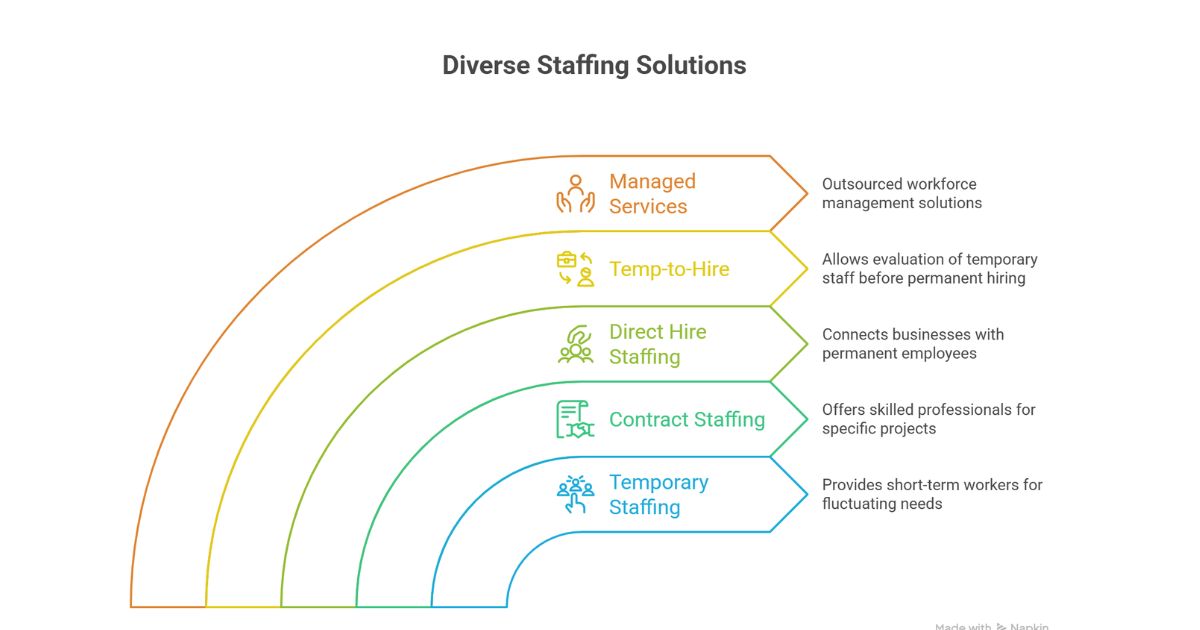
Staffing services help tech companies:
- Fill highly specialized roles quickly
- Scale teams for product launches or projects
- Access niche technical expertise
Key benefit: Faster hiring in a highly competitive talent market.
6.3 Manufacturing & Engineering Staffing
This is where industrial staffing services play a critical role. Manufacturing and engineering industries rely heavily on a skilled workforce to maintain productivity, safety, and operational efficiency.
Key roles include:
- Production Workers
- Machine Operators
- Quality Control Inspectors
- Mechanical & Electrical Engineers
- Maintenance Technicians
Staffing agencies support:
- High-volume hiring
- Shift-based workforce needs
- Seasonal production demand
- Skilled trade shortages
Key impact: Industrial staffing helps maintain production efficiency, reduce downtime, and meet delivery deadlines.
6.4 Administrative & Operations Staffing
Every organization needs a strong operational backbone. Administrative staffing ensures that day-to-day business functions run smoothly.
Roles include:
- Office Administrators
- HR Assistants
- Data Entry Specialists
- Customer Service Representatives
- Operations Coordinators
Staffing services in this area help:
- Maintain business continuity
- Support internal teams
- Improve workflow efficiency
Key benefit: Strong operational support without overburdening internal teams.
7. Common Hiring Challenges Solved by Staffing Agencies
Hiring today is not just difficult—it’s unpredictable. Businesses across industries face constant pressure to find the right talent quickly while controlling costs and maintaining productivity. This is where staffing agencies step in as problem-solvers, not just service providers.
Think of staffing agencies as a shock absorber for your workforce—they reduce the impact of hiring challenges and keep your operations running smoothly.
Talent Shortages
One of the biggest challenges companies face today is the lack of available and qualified workers. Whether it’s skilled labor in manufacturing or specialized professionals in technical roles, the talent gap continues to grow.
Staffing agencies solve this by offering access to larger, pre-built candidate networks that go beyond what a company can reach on its own. They continuously source, engage, and maintain relationships with candidates, ensuring a steady pipeline of talent.
Result: You don’t have to start from zero every time you hire.
High Turnover Rates
Frequent employee turnover can disrupt operations, increase costs, and reduce team morale. Hiring the wrong candidate often leads to repeated replacements and wasted resources.
Staffing agencies reduce turnover by:
- Conducting deeper screening and assessments
- Matching candidates based on both skills and cultural fit
- Offering temp-to-hire options to test performance before full commitment
Outcome: Better hiring decisions lead to stronger retention and long-term stability.
Seasonal Demand Fluctuations
Many industries experience peaks and slow periods. For example, manufacturing plants may need extra workers during high production cycles, while logistics companies see demand spikes during holidays.
Hiring permanent employees for temporary demand creates inefficiencies.
Staffing agencies provide flexible workforce solutions, allowing businesses to scale up during busy periods and scale down when demand drops.
Think of it like adjusting your workforce like inventory—only what you need, when you need it.
Skill Gaps in the Workforce
Modern jobs increasingly require specialized skills, especially in technical and industrial roles. Finding candidates with the right expertise can be time-consuming and challenging.
Staffing agencies bridge this gap by:
- Sourcing niche talent
- Conducting skill-based evaluations
- Providing access to experienced professionals
Result: Faster placement of qualified candidates without compromising quality.
Long Hiring Cycles
Traditional hiring processes can take weeks or even months. This delay can lead to lost productivity, missed deadlines, and increased workload on existing employees.
Staffing agencies streamline the entire hiring workflow by:
- Using pre-screened candidate pools
- Reducing sourcing and screening time
- Accelerating interview and onboarding processes
Outcome: Positions are filled faster, and operations continue without disruption.
8. How to Choose the Right Staffing Agency
The agency you select directly impacts your hiring speed, workforce quality, compliance, and overall operational success.
Think of a staffing partner like an extension of your internal team. If they perform well, your business runs smoothly. If they don’t, hiring becomes a constant struggle.
So, how do you make the right choice?
8.1 Industry Expertise
Not all staffing agencies are the same. Some specialize in healthcare, others in IT, and some focus on industrial or manufacturing staffing.
Choosing an agency with proven experience in your industry ensures they understand:
- Role-specific skill requirements
- Industry regulations and compliance
- Market hiring trends
- Workforce challenges unique to your sector
For example, hiring for a manufacturing plant requires different expertise than hiring for a tech startup.
Key takeaway: The right expertise leads to better candidate matching and faster hiring.
8.2 Candidate Quality & Screening Process
The quality of candidates depends entirely on how well the agency screens them.
Before partnering, ask:
- What screening methods do you use?
- Do you conduct skill assessments or technical tests?
- Are background checks and reference verifications included?
Top staffing agencies follow a structured screening process that ensures candidates are not only qualified but also job-ready.
Why it matters: Better screening = fewer hiring mistakes and lower turnover.
8.3 Speed and Scalability
In many industries, hiring delays can lead to lost revenue, missed deadlines, and operational disruptions.
A reliable staffing partner should be able to:
- Fill positions quickly
- Handle urgent hiring needs
- Scale workforce up or down based on demand
Ask about their average time-to-fill and how they manage high-volume hiring.
Think of it this way: Your staffing partner should move at the speed of your business.
8.4 Compliance and Credentialing
Compliance is one of the most overlooked—but critical—factors in staffing.
A trustworthy agency must handle:
- Labor law compliance
- Worker classification (temporary vs full-time)
- Payroll taxes and documentation
- Industry-specific certifications and credentialing
Failure in compliance can lead to legal risks and financial penalties.
Bottom line: Choose an agency that protects your business, not one that creates risk.
8.5 Client Support & Communication
Even the best hiring process can fail without clear communication.
A strong staffing partner should provide:
- Regular updates on hiring progress
- Transparent communication
- Quick response times
- Ongoing support after placement
Good communication builds trust and ensures alignment between your expectations and their delivery.
Simple truth: Better communication leads to better hiring outcomes.
👉 Choosing a Trusted Partner
Working with a reliable staffing partner like Bluebix Inc can simplify your hiring process significantly. With industry expertise, strong screening methods, and a focus on compliance and speed, Bluebix helps businesses connect with qualified industrial talent quickly and efficiently.
9. Cost of Staffing Services: What to Expect
Understanding the cost of staffing services is essential for making smart hiring decisions. Many businesses assume staffing is expensive—but in reality, it often reduces total hiring costs when you consider the bigger picture.
Think of staffing not as an expense, but as an investment in efficiency, speed, and reduced risk.
Pricing Models
Staffing agencies typically use a few common pricing structures, depending on the type of service and role.
- Markup Model (Hourly Rate + Agency Fee)
This is the most common model for temporary and contract staffing.
- You pay an hourly rate for the worker
- The agency includes its service fee within that rate
For example, if a worker earns $20/hour, you might pay $28–$35/hour depending on the markup.
- Flat Fee Model
Used for specific roles or projects.
- A fixed amount is charged per hire
- Predictable and easy to budget
- Percentage of Salary Model
Common for direct hire placements.
- Typically 15%–30% of the candidate’s annual salary
- Paid once the candidate is successfully hired
Each model is designed to align with different hiring needs, whether short-term, project-based, or permanent.
Cost vs In-House Hiring
At first glance, in-house hiring may seem cheaper—but many hidden costs add up quickly:
- Job advertising and recruitment tools
- HR team salaries and time investment
- Training and onboarding expenses
- Productivity loss during long hiring cycles
- High turnover and replacement costs
Staffing services help convert these fixed and unpredictable costs into controlled, flexible expenses. You only pay for the talent you need when you need it.
Simple reality: Staffing reduces waste and improves cost efficiency.
ROI of Staffing Services
The true value of staffing is measured in return on investment (ROI), not just upfront cost.
By using staffing services, businesses gain:
- Faster productivity: Roles are filled quickly, reducing downtime
- Reduced hiring risks: Better screening lowers the chance of bad hires
- Improved workforce planning: Flexible hiring supports business growth
- Operational efficiency: Less burden on internal HR teams
Over time, these benefits often outweigh the initial cost of using an agency.
11. Future Trends in the Staffing Services Industry
The staffing services industry is evolving rapidly, driven by technology, changing workforce expectations, and global business demands. Companies that understand these trends today will be better prepared to build a future-ready workforce tomorrow.
Think of the future of staffing like a shift from manual driving to autopilot—faster, smarter, and more data-driven.
AI and Automation in Recruitment
Artificial Intelligence (AI) is transforming how companies find and hire talent. Instead of manually reviewing hundreds of resumes, AI-powered tools can quickly analyze candidate profiles and match them with job requirements.
These tools help:
- Identify the best-fit candidates faster
- Reduce human bias in hiring
As AI continues to evolve, recruitment will become more efficient, accurate, and scalable.
Key takeaway: Faster hiring with better precision.
Remote Workforce Growth
The rise of remote work has completely changed the hiring landscape. Companies are no longer limited to local talent—they can now hire from anywhere in the world.
This shift offers:
- Access to a global talent pool
- Reduced overhead costs (office space, relocation)
- Increased flexibility for both employers and employees
Staffing agencies are adapting by offering remote hiring solutions, helping businesses tap into talent without geographical limitations.
Impact: Talent is no longer defined by location.
Skills-Based Hiring
Traditional hiring focused heavily on degrees and formal education. Today, companies are shifting toward skills-based hiring, where practical abilities matter more than academic qualifications.
Employers now prioritize:
- Hands-on experience
- Technical skills
- Problem-solving ability
This trend allows businesses to find capable candidates who may not follow traditional career paths but deliver strong performance.
Result: A more diverse and capable workforce.
Gig Economy Expansion
More professionals are choosing flexible work arrangements instead of full-time roles. This has led to the rapid growth of the gig economy.
Workers now prefer:
- Short-term contracts
- Freelance opportunities
- Project-based work
For businesses, this means access to on-demand talent without long-term commitments.
Think of it as “work on demand” instead of hire and hold.
Data-Driven Workforce Planning
Modern staffing is no longer based on guesswork. Companies are using data and analytics to make smarter hiring decisions.
With data-driven insights, businesses can:
- Predict future hiring needs
- Identify skill gaps in advance
- Optimize workforce costs
- Improve hiring strategies over time
Staffing agencies are increasingly offering these insights as part of their services.
Key benefit: Smarter planning leads to better business outcomes.
When Should You Use Staffing Services?
Knowing when to use staffing services is just as important as understanding what they are. Many businesses wait too long and struggle with delays, lost productivity, and hiring stress. The truth is, staffing services work best when used proactively, not reactively.
Think of staffing services like a strategic backup system—you may not need them every day, but when demand spikes or challenges arise, they keep your operations running smoothly.
You Need to Hire Quickly
If your business has urgent hiring needs, traditional recruitment methods may be too slow. Posting jobs, screening candidates, and scheduling interviews can take weeks.
Staffing agencies provide pre-vetted, ready-to-work candidates, allowing you to fill positions in days instead of weeks.
Best use case: Sudden vacancies, urgent production deadlines, or unexpected workload increases.
Your Business Is Growing Fast
Rapid growth is exciting—but it also creates hiring pressure. Scaling your workforce too slowly can limit your ability to meet demand.
Staffing services help you scale quickly without overloading your internal HR team, ensuring your growth stays on track.
Key benefit: Grow your team at the same speed as your business.
You Have Project-Based Work
Not every role needs to be permanent. Many businesses require talent for short-term projects, system upgrades, or seasonal operations.
Staffing agencies allow you to bring in skilled professionals only for the duration of the project, avoiding long-term commitments.
Example: Hiring engineers for a 6-month automation project.
You Need Specialized Skills
Some roles require niche expertise that is difficult to find through traditional hiring channels.
Staffing agencies have access to specialized talent pools, making it easier to fill technical or hard-to-find roles quickly and efficiently.
Result: Faster access to the right expertise without long search cycles.
You Face Seasonal Demand
Many industries experience demand fluctuations throughout the year. Hiring full-time employees for temporary demand can increase costs and inefficiencies.
Staffing services provide flexible workforce solutions, allowing you to scale up during peak seasons and scale down when demand decreases.
Think of it as adjusting your workforce like inventory—only what you need, when you need it.
Conclusion
Industrial staffing services have transformed how businesses hire, manage, and scale their workforce. In a world where speed, flexibility, and efficiency matter more than ever, relying solely on traditional hiring methods can hold companies back. Staffing services offer a smarter, faster, and more cost-effective way to build strong teams.
From reducing hiring time to ensuring compliance and accessing skilled talent, the benefits are clear. Whether you’re managing a factory floor, running operations, or planning workforce expansion, the right staffing partner can make a measurable difference.
If your business wants to stay competitive, improve productivity, and reduce hiring risks, now is the time to explore staffing solutions. Partnering with experts like Bluebix Inc can help you build a workforce that drives real results.
10 FAQ Section
What does direct hire staffing mean in healthcare?
Direct hire staffing means recruiting healthcare professionals for permanent or long-term positions within an organization.
Instead of filling shifts temporarily, employers hire candidates as part of their regular workforce. This model helps build consistency, improve retention, and support stronger patient care across hospitals, clinics, and care facilities over time.
How is direct hire staffing different from temporary healthcare staffing?
Temporary staffing fills short-term gaps, urgent shifts, or seasonal demand. Direct hire staffing focuses on full-time or long-term placements that become part of the employer’s internal team.
Healthcare employers choose direct hire when they want stability, a stronger culture fit, and reduced turnover rather than only immediate short-term coverage needs.
Is direct-hire staffing a good option for hiring nurses?
Yes. Direct hire staffing is often a strong option for registered nurses, licensed practical nurses, and specialty nursing roles when employers want long-term retention and dependable care delivery. It helps organizations find screened, qualified candidates who match schedule needs, clinical expectations, and team culture instead of only filling temporary gaps.
What types of healthcare facilities benefit most from direct hire staffing?
Hospitals, outpatient clinics, long-term care centers, rehabilitation facilities, home health agencies, and specialty practices can all benefit.
It is especially useful for organizations with recurring vacancies, growth plans, or hard-to-fill roles where hiring the right long-term employee matters more than simply covering shifts for a short period.
Can direct hire staffing help reduce employee turnover?
Yes. A strong direct hire process improves retention by focusing on candidate quality, job fit, work expectations, and organizational culture.
When healthcare employers hire more intentionally, they reduce costly turnover, improve team morale, and create a more stable staffing environment that supports both workers and patient care performance.
What should a healthcare employer look for in a direct hire staffing agency?
Look for healthcare-specific expertise, proven screening methods, credential verification, responsive communication, and success in filling similar roles.
A strong agency should understand clinical hiring challenges, move quickly without sacrificing quality, and provide a shortlist of candidates who are qualified, reliable, and aligned with the employer’s staffing goals and values.
Does direct hire staffing only work for large hospitals?
No. Smaller clinics, physician groups, surgical centers, home health providers, and long-term care organizations also use direct hire staffing.
Any healthcare employer that needs dependable full-time staff, better hiring efficiency, or improved candidate quality can benefit from a direct hire approach, regardless of organization size or hiring volume.
How long does the direct hire staffing process usually take?
The timeline depends on the role, market conditions, licensing needs, interview speed, and decision-making process. Some roles move quickly, while specialized healthcare positions take longer.
Employers often shorten hiring time by using a staffing partner that pre-screens candidates, verifies credentials, and keeps communication moving throughout the recruitment process.
Is direct hire staffing worth the cost for healthcare organizations?
Often, yes. While there is a recruitment cost, the value comes from reducing vacancy time, lowering turnover, improving candidate quality, and saving internal team resources. For many healthcare employers, the long-term return is stronger than the cost of repeated hiring delays, poor-fit employees, or overworked internal recruitment teams.
How does direct hire staffing support better patient care?
Better hiring leads to more consistent staffing, less burnout, and stronger team collaboration. When healthcare organizations place qualified professionals in long-term roles, they improve continuity of care and reduce disruption.
That stability can positively affect patient experience, operational efficiency, and trust in the care team across the organization.
About the Author
BluebixInc Editorial Team
Staffing insights and workforce solutions for employers.