

7 Hiring Solutions for Head of Manufacturing Staffing Agency
If you searched for head of manufacturing staffing agency, You are looking for a solution. You want help filling critical manufacturing roles faster, with better-fit people, and less turnover. In manufacturing, open jobs do not stay on paper.
They show up on the floor as missed output, overtime, quality issues, and pressure on supervisors. The right staffing partner does more than send resumes. It helps you protect operations, reduce hiring risk, and build a stronger workforce strategy.
What Is a Head of Manufacturing Staffing Agency?
A head of manufacturing staffing agency is the senior leader who shapes how a specialized staffing firm serves manufacturers.
This person usually sits above day-to-day recruiting and focuses on strategy, client outcomes, delivery quality, talent pipelines, and industry alignment.
In simple terms, this is the person responsible for making sure the agency understands manufacturing the way manufacturers understand it.
That means shift realities, safety requirements, production goals, plant culture, technical roles, leadership needs, and the business impact of a bad hire.
That is very different from a general staffing leader. A broad staffing firm may know how to fill jobs across many sectors.
A specialized manufacturing staffing leader knows the difference between hiring a maintenance technician for a high-speed packaging line and hiring a production supervisor for a multi-shift automotive plant. That difference matters.
For HR directors, talent acquisition leaders, plant managers, operations directors, and manufacturing owners, the real value is strategic. You are not just buying recruiting hours. You are choosing whether your staffing partner can think like an operator, not just like a recruiter.
What Does a Manufacturing Staffing Agency Actually Do?
A manufacturing staffing agency helps employers fill roles across several hiring models:
Direct hire
This is best for long-term positions where retention, leadership continuity, and culture fit matter most. Think of plant managers, manufacturing engineers, quality leaders, and skilled trades professionals you want to keep.
Temporary staffing
This is often used when production demand jumps, absenteeism rises, or a facility needs fast coverage. Temporary staffing can help stabilize operations without locking in a long-term commitment too early.
Contract-to-hire
This model gives employers a chance to evaluate fit before making a permanent offer. It is like a test drive before buying the machine. For high-risk roles or uncertain demand, it can reduce hiring mistakes.
Workforce planning support
The best agencies do more than post jobs and forward resumes. They help define role requirements, advise on hiring models, benchmark the market, improve job ads, and create pipelines for future needs.
That is why the strongest manufacturing staffing agency is not a resume shop. It is a workforce partner.
Who Needs a Manufacturing Staffing Agency Most?
Not every company needs outside help all the time. But many manufacturing employers reach a point where internal recruiting alone is not enough.
HR Managers and HR Directors
HR leaders often carry the weight of time-to-fill, turnover, compliance, and cost-per-hire. When roles stay open too long, they feel the pressure from every direction. A manufacturing staffing agency can reduce that strain by bringing in specialized sourcing, faster screening, and better-fit talent.
Talent Acquisition Managers
TA teams may be strong, but they still hit bottlenecks. Multi-site hiring, hard-to-fill technical roles, and high-volume openings can stretch internal teams thin. An outside partner gives them bandwidth and market reach.
Plant Managers
Plant managers care about one thing above almost everything else: keeping production moving. When open roles create overtime, burnout, missed schedules, or safety risk, staffing becomes an operations issue, not just an HR issue.
Operations Managers and Directors
Operations leaders need labor stability. They need people who can show up, work safely, understand the environment, and keep output steady. A general recruiter may miss these details. A specialized industrial recruiting firm should not.
Manufacturing Owners, COOs, and VP Operations
Senior leaders think in bigger terms: growth, customer commitments, labor cost, quality, and risk. They want a staffing strategy that supports scale, protects performance, and helps the business stay competitive.
The Real Hiring Problems Manufacturing Employers Are Trying to Solve
Here is what manufacturing employers are really dealing with right now.
Manufacturing remains a large and active sector. According to the U.S. Census Bureau, new orders for manufactured goods in January 2026 rose to $620.1 billion, shipments rose to $612.9 billion, and unfilled orders increased to $1.54 trillion, showing that many manufacturers are still operating in a high-pressure environment where labor gaps can quickly affect output.
At the same time, the workforce challenge is not going away. The National Association of Manufacturers reported in 2025 that the U.S. could face a shortfall of 1.9 million manufacturing workers by 2033, with 3.8 million positions expected to open during that period.
That pressure shows up in several ways:
Skilled labor shortages
Many companies struggle to find maintenance technicians, machinists, welders, CNC operators, quality engineers, automation specialists, and experienced supervisors. These are not roles you fill well with a generic database blast.
High turnover
Plant-floor turnover can feel like filling a leaky bucket. You hire, onboard, train, and then start over again. Every early exit costs time, money, and team morale.
Urgent hiring needs
When a line goes down, a supervisor leaves, or an expansion ramps up, hiring delays hurt quickly. In manufacturing, waiting is expensive.
Safety and compliance concerns
A poor-fit hire in manufacturing is not just inconvenient. It can raise safety risk, affect quality, slow onboarding, and create headaches for team leads.
Leadership gaps
A missing plant manager, operations leader, or production supervisor has a ripple effect. Leadership vacancies often create confusion, weak communication, and slower decision-making on the floor.
Benefits of Working With a Specialized Manufacturing Staffing Agency
A good manufacturing staffing partner brings five major benefits.
1. Faster hiring for business-critical roles
Speed matters. BLS data shows manufacturing had 495,000 job openings in January 2026, up from 400,000 in December 2025. That does not mean every plant is hiring at the same pace, but it does show an active and competitive labor market.
A specialized agency can move faster because it already knows the talent pools, the common screening questions, and the difference between must-have skills and nice-to-have wish lists.
2. Better candidate quality
Good manufacturing recruiters screen for more than keywords. They look at plant experience, machine exposure, shift flexibility, safety awareness, attendance patterns, supervisory fit, and technical depth.
That improves candidate quality because the process is grounded in the work itself, not just in a job description.
3. Reduced operational disruption
Open jobs push more hours onto the people who stay. That leads to fatigue, mistakes, and burnout. The right staffing partner helps lower that pressure by shortening vacancy time and improving fill consistency.
4. Access to passive candidates
The best people are often not actively applying. They are working. Specialized recruiters know how to reach these candidates, build relationships, and bring them into the conversation.
5. Stronger retention
Fast hiring is not enough. The right hire should last. Strong agencies improve retention by focusing on role match, culture fit, supervisor expectations, plant environment, and schedule realities.
It is like fitting the right part into the right machine. Even a high-quality part will fail if the fit is wrong.
Roles a Manufacturing Staffing Agency Can Help Fill
A specialized manufacturing staffing agency can support hiring across several role families.
Plant leadership roles
- Plant Manager
- Operations Manager
- Production Manager
- Production Supervisor
- Shift Supervisor
- Maintenance Manager
- Quality Manager
These roles influence output, morale, communication, and accountability. They require more than leadership on paper. They require credibility in a production environment.
Skilled trades roles
- Maintenance Technician
- Industrial Electrician
- Welder
- Machinist
- CNC Operator
- Tool and Die Maker
- PLC Technician
These are often some of the hardest roles to fill because the labor pool is narrow and demand is steady.
Engineering and technical roles
- Manufacturing Engineer
- Process Engineer
- Quality Engineer
- EHS Specialist
- Automation Engineer
- Controls Engineer
- Reliability Engineer
These hires matter because they sit at the intersection of performance, quality, safety, and continuous improvement.
Support and operations roles
- Production Planner
- Buyer / Procurement Specialist
- Inventory Analyst
- Logistics Coordinator
- Warehouse Supervisor
- Scheduler
These jobs may not always get top billing, but they keep the system moving.
How a Head of Manufacturing Staffing Agency Adds Strategic Value
This is where leadership matters.
A recruiter can fill a role. A leader at a manufacturing director staffing agency should be able to shape a hiring strategy.
They understand plant realities
Manufacturing is not one thing. A food plant, medical device facility, metal shop, and high-volume automotive supplier all have different rhythms, risks, and labor challenges. Strategic staffing leadership means understanding those differences.
They advise on the right hiring model
Not every opening should be filled the same way. A good staffing leader helps you decide whether a role should be a direct hire, temp, or contract-to-hire based on urgency, cost, risk, retention goals, and business impact.
They improve process quality
Agency leadership should set standards for intake calls, screening depth, candidate communication, reporting, and follow-up. That creates consistency across placements.
They think beyond today’s vacancy
The best staffing leaders look at patterns. Why are certain jobs always hard to fill? Why are some teams losing people faster? Why does one plant hire better than another? Those answers help shape a stronger long-term workforce strategy.
How the Manufacturing Staffing Process Works From Intake to Placement
The strongest staffing process is not flashy. It is disciplined.
1. Intake and discovery
The agency should start by understanding:
- the exact role
- shift schedule
- reporting line
- plant environment
- must-have skills
- safety requirements
- reasons the role is open
A vague intake usually creates weak candidates.
2. Market mapping and sourcing
Recruiters identify likely talent pools, search active and passive candidates, and tailor outreach based on the role and plant context.
3. Screening and qualification
For leadership roles, it should also assess problem-solving, team management, and a continuous improvement mindset.
4. Candidate presentation
Good agencies do not flood you with resumes. They send fewer, better candidates with clear notes on why each person matches the role.
5. Interview coordination
The agency helps manage scheduling, candidate preparation, feedback flow, and offer communication.
6. Onboarding and follow-up
Strong agencies stay involved after the offer. They help reduce drop-off risk, support start readiness, and check in after placement.
How to Choose the Right Manufacturing Staffing Agency
If you are comparing staffing partners, do not begin with the biggest brand name or the broadest service list. Start with fit.
In manufacturing, the right staffing agency model should understand how your business runs, what your workforce challenges look like, and what kind of people can actually succeed in your environment.
A well-known agency may have reach, but reach alone does not guarantee good hires. What matters most is whether the firm can support your specific plant, roles, pace, and hiring goals.
Look for true specialization
Many staffing firms say they support manufacturing. Far fewer truly specialize in it. That distinction matters. A firm that occasionally fills manufacturing roles is not the same as one that works in the industry every day and understands its hiring realities in detail.
One of the best ways to test this is to ask direct questions. What percentage of their work is in manufacturing or industrial hiring? Which roles do they fill most often?
What types of facilities do they support? If their answers stay broad or sound too polished without real detail, that may be a sign that manufacturing is only a small part of what they do.
Check role relevance
Not every manufacturing staffing agency is equally strong across all types of roles. Some are best at high-volume production staffing. Others are more experienced in skilled trades, engineering staffing, or plant leadership. That is why role relevance matters.
The closer their track record is to your real hiring need, the more likely they are to bring the right sourcing strategy, screening process, and candidate network.
Ask about screening depth
A resume alone does not tell you whether a candidate will succeed in a manufacturing role. That is why screening depth is one of the most important areas to review when choosing a staffing agency.
A good agency should be able to explain how it evaluates technical skill, work history, reliability, shift fit, attendance patterns, safety awareness, and communication style. For leadership roles, they should also assess management approach, team leadership, decision-making, and fit with operational goals.
Review communication and reporting
Even a firm with strong recruiting Skills gap can become frustrating to work with if communication is weak. That is why it is important to review how the agency manages updates, timelines, feedback, and reporting.
A good staffing partner should be responsive, organized, and direct. You should not have to chase them for updates or guess where the search stands. They should be clear about what they are seeing in the market, how many candidates they have reached, where challenges exist, and what realistic timelines look like.
Evaluate retention thinking
Almost every staffing agency can talk about speed. Many can talk about fill rates. Fewer can explain how they help improve retention. That is one of the best ways to separate a short-term recruiter from a stronger long-term staffing partner.
Retention matters because a fast hire is not always a successful hire. If the person leaves in a few weeks, struggles in the environment, or fails to meet expectations, the vacancy simply returns with more cost attached to it.
That is why it is important to ask how the agency thinks about staying power, not just placement speed.
Test scalability
Can they support one urgent search and a multi-site ramp at the same time? Can they handle skilled trades, leadership, and technical roles if your needs change?
When buyers search for the best manufacturing staffing agencies near me, they are often asking two real questions:
- Can this firm understand my plant?
- Can this firm deliver people I would actually hire?
That is the right filter.
Direct Hire vs Temp vs Contract-to-Hire in Manufacturing
Choosing the wrong hiring model is like using the wrong tool on the line. You may still get motion, but not good results.
When direct hire makes the most sense
Use direct hire when the role is:
- strategic
- hard to replace
- leadership-heavy
- tied to long-term retention
- important for culture or continuity
This often includes plant managers, engineers, quality leaders, and experienced skilled trades talent.
When temp staffing makes sense
Use temp staffing when you need:
- fast coverage
- seasonal support
- surge staffing
- short-term relief
- flexibility during uncertain demand
Temp staffing helps stabilize the floor when speed matters most.
When contract-to-hire makes sense
Use this when:
- Fit is hard to judge in interviews
- The role is important but not yet fully defined
- You want to reduce hiring risk
- Demand could change
This model can work well for supervisors, technicians, and some mid-level operations roles.
How to decide
Match the hiring model to:
- urgency
- cost tolerance
- retention goals
- training burden
- Business risk of a poor hire
The best staffing partner should help you make that decision clearly.
Common Mistakes Employers Make When Hiring for Manufacturing Roles
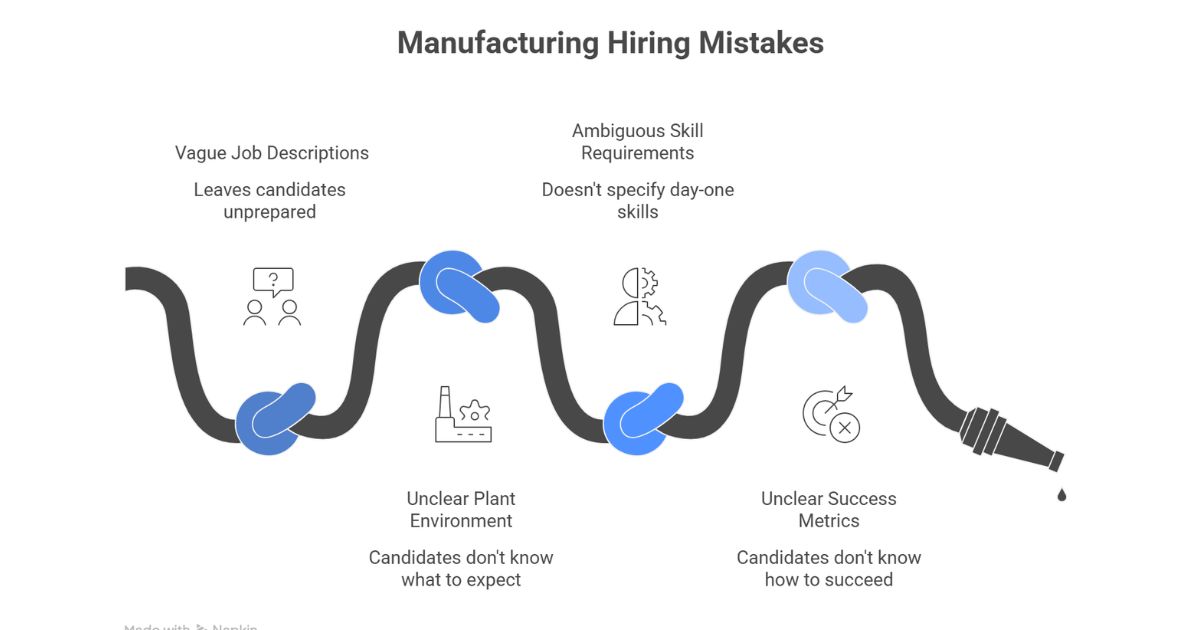
In this environment, the cost of a hiring mistake can be high. A poor hire can slow production, increase overtime, affect safety, frustrate supervisors, and create turnover that forces the team to start over again. That is why it helps to look closely at the most common mistakes employers make when hiring for manufacturing roles.
Writing vague job descriptions
A strong manufacturing job description should do more than list a job title and a few duties.
It should clearly explain the real nature of the work. Candidates need to know what kind of plant environment they will be stepping into, what shift they will be working, what machines or systems they will be around, what skills are required on day one, and how success will be measured.
For example, “maintenance technician needed” is too broad. It leaves too many questions open.
Is the role focused on electrical troubleshooting, mechanical repair, PLC support, or preventive maintenance? Is it first shift or overnight? Is the plant fast-paced and high-volume, or smaller and more specialized? These details matter because they help attract candidates who are actually prepared for the role.
Hiring too slowly
This is especially risky in manufacturing because many skilled workers, supervisors, and technical professionals do not stay on the market for long. Good candidates often have multiple options. If one employer moves quickly and another takes too much time, the faster company usually wins.
Slow hiring also creates a poor impression. Candidates may assume the company is disorganized, unsure, or not serious about the role. That can weaken interest even before an offer is made.
Ignoring plant culture and schedule fit
A candidate may have the technical skill but still fail if the schedule, leadership style, or work pace is not a fit.
Treating all staffing vendors the same
Many employers assume that one staffing firm is much like another. That assumption can be costly. In reality, staffing vendors vary widely in how they source candidates, how deeply they screen, how well they understand manufacturing roles, and how seriously they support long-term hiring success
The mistake many employers make is choosing a staffing vendor based only on short-term convenience or low cost. On the surface, a cheaper option may look attractive.
But hidden costs often show up later in the form of weak candidates, poor retention, more interview time, longer vacancy periods, and repeated hiring cycles.
Focusing only on fill rate
Fill rate is an important hiring metric, but it should never be the only one. A role being filled does not automatically mean the hiring effort was successful.
If the person leaves quickly, struggles in the environment, creates team friction, or cannot meet performance expectations, then the position may be filled on paper while the real problem remains unsolved.
This is one of the most common mistakes in manufacturing hiring. Employers become so focused on closing the vacancy that they do not look closely enough at what happens after the start date.
But in manufacturing, the real measure of success is not just whether someone accepted the offer. If you want to know common hiring mistakes, click here
Where a Manufacturing Staffing Agency Fits Into Long-Term Workforce Planning
A manufacturing staffing agency should not only help in emergencies. It should also support long-term planning.
Expansion support
When production grows, customer demand increases, or a new line launches, labor needs often rise quickly. Many companies focus first on equipment, schedules, output targets, and customer timelines.
This kind of support is especially useful during:
- plant expansions
- new product launches
- seasonal production increases
- multi-site growth
- new shift rollouts
Think of it like preparing raw materials before a production run. If labor planning starts too late, the entire ramp-up can slow down. A staffing partner helps make sure workforce planning keeps pace with business growth.
Replacement planning
Replacement planning is much easier when a talent pipeline already exists. A manufacturing staffing agency can help companies prepare for likely vacancies before they happen. That includes identifying positions with high turnover risk, roles tied to retirement trends, or jobs that are consistently difficult to fill.
This is especially important for:
- plant leadership roles
- skilled trades positions
- maintenance and technical jobs
- engineering roles
- supervisors and team leads
When a company has no pipeline, every departure becomes a scramble. But when replacement planning is already in motion, transitions are smoother, hiring is faster, and operations stay more stable. In that way, a staffing agency supports continuity, not just recruiting.
Talent market insight
One of the biggest advantages of working with a specialized manufacturing staffing agency is market visibility. A strong agency often has a sharper view of the labor market than an internal team can maintain alone, especially when internal recruiters are already busy with day-to-day hiring demands.
That insight can help leaders make smarter workforce decisions. A specialized agency may be able to tell you:
- which roles are becoming harder to fill
- where candidate supply is tightening
- how pay expectations are changing
- which shifts are hardest to staff
- what competitors may be doing to attract talent
- why certain roles attract applicants but fail at the offer stage
This kind of information matters because workforce planning is not only about how many people you need. It is also about how realistic your hiring expectations are in the current market.
Workforce balance
Leaders need to balance speed, cost, quality, and compliance. A good staffing strategy helps make those trade-offs smarter.
BLS data also shows manufacturing employment remained around 12.6 million in early 2026, with average hourly earnings for all employees in manufacturing at $36.39 in February 2026. In other words, this is still a major workforce market where compensation, availability, and competition matter.
How to Know It’s Time to Partner With a Manufacturing Staffing Agency
Many manufacturing companies wait too long before asking for outside hiring support. They try to solve every staffing problem internally, even when the signs are clear. Here are the clearest signs that it may be time to bring in a specialized partner.
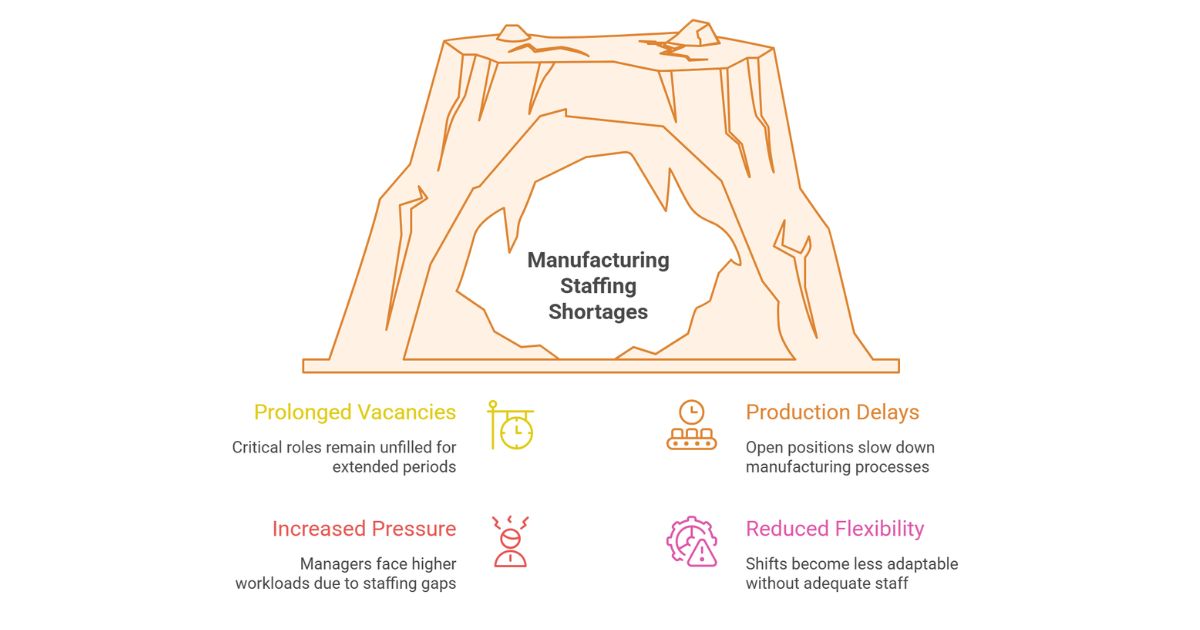
Roles stay open too long
When critical positions stay vacant for weeks or months, the problem is already costing more than most teams realize. An open role is not just an empty seat.
It often means slower production, delayed projects, more pressure on managers, and less flexibility across shifts. If the vacancy is in maintenance, quality, supervision, engineering, or operations leadership, the impact can spread even faster.
Overtime keeps rising
Overtime can help during short-term spikes, but when it becomes the normal way to keep production moving, it often points to a deeper staffing gap.
The same people keep stepping in, covering open shifts, handling extra workload, and stretching beyond their regular responsibilities. At first, it may look manageable. Over time, it starts to wear people down.
Internal recruiting is overloaded
Many internal recruiting teams are skilled, hardworking, and fully capable. The problem is not always quality. Often, it is capacity.
A lean HR or talent acquisition team may already be managing onboarding, compliance, scheduling, interviews, employee issues, and hiring across multiple departments. Adding several hard-to-fill manufacturing roles on top of that can create a bottleneck very quickly.
You keep seeing the same weak applicants
If you keep posting jobs and seeing the same low-fit candidates again and again, it usually means your hiring channels are too limited.
You may be fishing in the same pond every time and expecting a different result. That is frustrating for HR, frustrating for hiring managers, and costly for the business.
Production performance is feeling the labor impact
This is one of the strongest warning signs. Once staffing gaps begin affecting production performance, the issue is no longer just about hiring. It is about business results.
Leadership searches are dragging
Leadership vacancies in manufacturing are especially costly. When a plant manager, operations manager, production supervisor, or maintenance leader’s role stays open too long, the team often loses direction. Decisions get slower.
Communication becomes less clear. Accountability can weaken. Even strong teams usually need steady leadership to stay aligned.
What the Reader Really Wants
Let’s step back and answer the real question behind the keyword.
If someone types head of manufacturing staffing agency, they are usually not researching a title for curiosity. They want to know:
- Who can help us hire better in manufacturing?
- How do we avoid wasting time on the wrong staffing partner?
- Can a specialist really improve speed, quality, and retention?
- What should we look for before we commit?
The honest answer is yes, a specialist can help a great deal, but only if that agency truly understands manufacturing operations. The right partner should feel like someone who can walk your floor mentally, even before they walk it physically. They should understand why one vacancy can slow an entire shift, why bad attendance hurts more than a weak resume, and why a plant manager hire is never just a hiring event. It is an operations decision.
Conclusion: A Specialized Manufacturing Staffing Partner Is a Business Solution, Not Just a Hiring Vendor
Manufacturing hiring is not just about filling open seats. It is about protecting output, reducing overtime pressure, improving retention, and giving leaders a more stable workforce.
That is why the best manufacturing staffing agency is not simply the one with the biggest database or the loudest pitch. It is the one that understands your plant, your roles, your pace, your risks, and your goals.
Whether you searched for head of manufacturing staffing agency, manufacturing director staffing agency, or best manufacturing staffing agencies near me, the end goal is the same: find a partner who can help you hire smarter.
In a market where manufacturers still face meaningful labor pressure, rising competition for talent, and long-term workforce gaps, choosing the right staffing partner is not a side decision. It is a business decision.
If your roles stay open too long, your supervisors are stretched, or your internal team is stuck in reactive hiring mode, now is the right time to review your staffing strategy.
FAQs
What is a head of manufacturing staffing agency?
It usually refers to the senior leader at a specialized manufacturing staffing firm who shapes recruiting strategy, client delivery, talent pipelines, and service quality for manufacturing employers.
Is a manufacturing staffing agency only for high-volume hiring?
No. It can help with one critical plant manager search, a handful of skilled trades hires, or a large multi-site ramp. The value is specialization, not only scale.
What makes a manufacturing staffing agency different from a general recruiter?
A specialist understands plant environments, shift work, safety expectations, skilled trades, engineering roles, and the business impact of labor gaps in production settings.
Can a manufacturing staffing agency help with leadership roles?
Yes. Many support hiring for plant managers, production supervisors, operations leaders, quality managers, and other hard-to-fill leadership positions.
What should HR ask before choosing an agency?
Ask about manufacturing specialization, roles filled, screening methods, retention metrics, communication style, replacement policies, and support for urgent or multi-site hiring.
How can a staffing agency reduce turnover in manufacturing?
By improving role fit, shift fit, supervisor alignment, candidate expectations, and onboarding support. Better matching usually leads to stronger retention.
Do staffing agencies help with skilled trades and engineering roles, too?
Yes. Good agencies often recruit for machinists, welders, industrial electricians, maintenance technicians, process engineers, quality engineers, and automation roles.
Why do plant managers care about staffing strategy?
Because labor gaps affect output, overtime, quality, and safety. For plant leaders, staffing is not just HR work. It is part of operational performance.
How do I know if my company needs a manufacturing staffing partner now?
If vacancies stay open too long, overtime keeps climbing, internal recruiting is stretched, or production goals are feeling labor pressure, it is time to consider outside help.